
- > ARC Raiders Search Lockers Trials Guide: Best Maps, Routes, Tips and How to Get 3 Stars Fast
- > How to Get the Canto Blueprint in Arc Raiders
- > How to Get THE FINALS Skin in ARC Raiders
- > How to Complete Battening Down Quest in Arc Raiders
- > How to Get the Frequency Modulation Boxes in ARC Raiders
- > ARC Raiders Crane House Key Guide: Location, Loot, and Best Farming Tips
Husk Graveyard Arc Raiders Guide – How to Farm Rare ARC Parts Efficiently
If you have spent any real time in Arc Raiders, you already know that not all map conditions are created equal. Some exist to crank up tension. Others exist to punish greedy routing. Husk Graveyard Arc Raiders sits in a rare middle ground. It quietly turns an average expedition into one of the most efficient farming runs in the game, as long as you understand what is changing under the hood.
This guide is written from a veteran raider’s perspective. No theorycraft fluff, no hype for hype’s sake. Just practical knowledge about how the Husk Graveyard event works, where it appears, how it changes difficulty, and why experienced players actively plan their sessions around it.
What Is Husk Graveyard in Arc Raiders
Husk Graveyard in Arc Raiders is a rotating map condition that increases the number of destroyed ARC machines scattered across the map. Instead of focusing on one big objective, the entire play space becomes dense with lootable wrecks. You will find more broken Wasps, grounded Couriers, fallen Rocketeers, and large First Wave shells than usual.
The important detail is this. These are dead machines, not live threats. That single change completely reshapes the risk versus reward balance of a raid.
When Husk Graveyard Arc Raiders is active, you can pull high tier ARC components that normally require killing dangerous enemies. You trade combat risk for positioning risk, noise management, and awareness. For players pushing workshop upgrades or crafting late game gear, that trade is often worth it.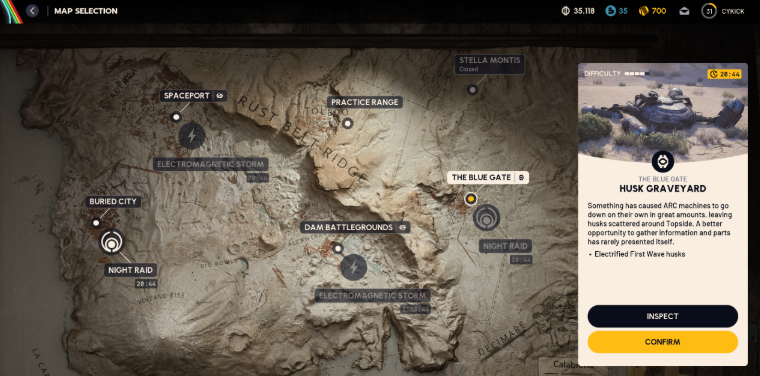
Maps Where Husk Graveyard Can Appear
Husk Graveyard Arc Raiders does not appear everywhere. It rotates between four maps in the standard playlist.
Dam Battlegrounds
Spaceport
Buried City
The Blue Gate
Each map handles the modifier slightly differently because of terrain, sightlines, and ARC patrol density. Dam Battlegrounds is the most forgiving. The Blue Gate is the most punishing. That difference matters a lot once PvP pressure enters the picture.
How Husk Graveyard Changes the Map
When the Husk Graveyard event is live, two major systems shift at the same time.
First, husk density increases across the entire map. You are not just finding a few extra wrecks. Routes that normally contain nothing but travel space suddenly become loot lanes. This includes small breachable husks like Wasps and Couriers, as well as larger Rocketeer and First Wave shells.
Second, First Wave husks gain a new behavior. When breached, they can discharge an electric burst. If you are standing too close when the breach finishes, you take damage and get briefly stunned. This is not lethal on its own, but it is extremely dangerous if another ARC patrol or player is nearby.
Loot tables are also affected. Husk Graveyard Arc Raiders increases the chance to pull rare ARC components from husks. These are parts typically associated with destroying high-tier machines, such as Bastions or Bombardiers.
There is also a small but noticeable increase in Nature loot. Food items and plant based resources are more common, which helps offset longer routes between wreck clusters.
Difficulty Scaling During Husk Graveyard
Husk Graveyard Arc Raiders quietly pushes map difficulty upward without announcing it through bosses or alarms.
Dam Battlegrounds shifts from a low pressure farming map into a mid tier risk zone. Spaceport and Buried City start feeling crowded, especially near points of interest. The Blue Gate becomes genuinely hostile, combining dense husks, heavy ARC presence, and high player traffic.
The difficulty increase does not come from stronger enemies. It comes from more things happening at once. You spend more time breaching, more time exposed, and more time making noise. That creates openings for patrols and other Raiders to collapse on you.
Veteran players adjust by shortening routes and committing to specific zones instead of trying to clear the entire map.
What Counts as a Husk During the Event
Not every wreck is created equal, but most breachable ARC remains count during Husk Graveyard Arc Raiders.
Wasp husks are small and fast to loot. They are excellent for stacking experience and components quickly. ARC Couriers tend to pay out better and are worth prioritizing if you spot them early. Rocketeer husks take longer to breach but have a higher chance of dropping rare materials.
First Wave husks are the main attraction. These large shells are slow, loud, and risky, but they are also the most reliable source of epic components during the event.
Baron husks are the exception. They are tied to Dormant Baron questlines and always spawn in fixed locations. Husk Graveyard does not increase their numbers or change their behavior.
Breaching Safely During Husk Graveyard
Breaching is where most players die during Husk Graveyard Arc Raiders. Not because the mechanic is unfair, but because it punishes impatience.
On First Wave husks, watch the shell as the breach completes. If you see sparks building, you need to move immediately. Finish the interaction, dodge away, let the electric discharge fire, then return to loot.
On smaller husks, the danger is not electricity. It is sound. Breach animations are loud and predictable. Standing still on a wreck is an open invitation for other Raiders or ARC patrols to line up shots.
Veteran habit is simple. Breach, disengage, scan, then loot. If you breach and immediately tunnel vision on the contents, you are already behind.
Why Husk Graveyard Is a Top Tier Farming Event
Husk Graveyard Arc Raiders shines because it removes one of the biggest costs in progression. Live combat.
During this event, you can pull parts like Bastion Cells, Bombardier Cells, Leaper Pulse Units, and other rare ARC materials without fighting the machines that normally guard them. You still take risk, but it is controllable risk.
Ammo usage drops. Healing usage drops. Exposure time becomes the main variable instead of raw damage output.
For players upgrading workshops from mid tiers into late game, one or two Husk Graveyard runs can replace several high risk combat focused raids.
This is also why PvP activity spikes during the event. Everyone knows the value is there.
Event Overlaps and Timing Awareness
Husk Graveyard Arc Raiders does not exist in isolation. It rotates alongside major events like Night Raid, Electromagnetic Storm, and Harvester.
When Husk Graveyard overlaps with Night Raid, visibility drops and Return Points become scarce. Loot value increases, but extraction routes become dangerous. When paired with Electromagnetic Storm, environmental damage adds pressure while you are breaching.
Experienced players check the schedule before committing. Walking into a stacked worst case event combination by accident is how good runs turn into losses.
Husk Graveyard and Baron Husks
It is important to separate normal husks from Baron husks.
Baron husks are massive carcasses used for Dormant Baron quests. On Dam Battlegrounds, three Baron husks always exist in fixed locations. One in the far west, one in the southwest near Water Treatment Control, and one in the east near The Breach guarded by a Sentinel.
The process for looting a Baron husk is loud, scripted, and dangerous. You climb, breach, retreat, wait for flames, then return.
Husk Graveyard Arc Raiders does not add more Baron husks. It simply increases the number of standard husks around them. If you are working on Dormant Barons, the event helps indirectly by padding your inventory with extra components on the way.
Routing Tips From Veteran Players
The biggest mistake newer players make during Husk Graveyard Arc Raiders is overcommitting.
You do not need to loot everything. Pick a section of the map, learn its husk spawns, and run it clean. Dam Battlegrounds favors linear routes. Spaceport rewards vertical awareness. Buried City punishes greedy backtracking. The Blue Gate demands discipline and early extraction planning.
Always assume another Raider is shadowing your route. Always assume a patrol will path through your breach location at the worst moment.
Husk Graveyard rewards calm play. Rushing turns value into losses fast.
Is Husk Graveyard Worth Playing Every Time
If you are early game and struggling with basic survivability, Husk Graveyard can feel overwhelming. More wrecks means more time exposed.
If you are mid to late game and chasing upgrades, Husk Graveyard Arc Raiders is one of the best conditions in the rotation. It compresses progression time and reduces the need to fight high tier enemies head on.
Players focused on building out arc raiders items for long term use should never skip this event unless it stacks with a particularly brutal major modifier.
Some players even choose to buy arc raiders items through trusted markets like G4mmo to skip early grind, but even then, Husk Graveyard remains valuable for rare components you simply cannot shortcut.
Final Thoughts on Husk Graveyard Arc Raiders
Husk Graveyard Arc Raiders does not announce itself with explosions or bosses. It rewards players who notice subtle shifts and adapt their playstyle.
More husks. More value. More risk if you are careless.
If you treat it like a normal raid, you will die more often than usual. If you treat it like a calculated salvage run, it becomes one of the most efficient progression windows in the game.
Veteran players do not chase Husk Graveyard for excitement. They chase it because it works. And in Arc Raiders, efficiency is often the difference between staying ahead of the curve or falling permanently behind.
Recommended Article


 Email
Email Discord