
- > ARC Raiders Search Lockers Trials Guide: Best Maps, Routes, Tips and How to Get 3 Stars Fast
- > How to Get the Canto Blueprint in Arc Raiders
- > How to Get THE FINALS Skin in ARC Raiders
- > How to Complete Battening Down Quest in Arc Raiders
- > How to Get the Frequency Modulation Boxes in ARC Raiders
- > ARC Raiders Crane House Key Guide: Location, Loot, and Best Farming Tips
Arc Raiders: Augmented Slots Explained
If you have been playing Arc Raiders for more than a few raids, you already know that carry space is everything. Whether you are going in for loot runs, pushing harder combat encounters, or just trying to recover gear after a tough loss, your inventory setup can make or break your run. And that is where augmented slots come into play. They are not just extra pockets or bonus grid space. Augmented slots define your loadout identity. They quietly shape how you approach every raid in Arc Raiders.
This guide breaks down exactly how augmented slots work, how they differ from standard backpack and Quick Use space, and how different augment types like Looting Mk.2 and Combat Mk.3 change your capacity, your survivability, and your role on the field. If you have ever wondered why some players can carry mountains of trinkets while you are constantly reshuffling just to pick up one more part, this is the explanation you have been missing.
What Are Augments in Arc Raiders
Before we talk about augmented slots specifically, it helps to understand what augments are in general. Augments are gear pieces you equip before going Topside. They determine several core parts of your loadout:
Carry space
Weight capacity
Shield compatibility
Number of Quick Use slots
Number of Safe Pocket slots
Augments are essentially your raid identity. A Tactical augment feels completely different from a Combat augment. Looting builds feel different from Healing builds. And while the slot numbers matter, the real shift happens when you reach augments with augmented slots.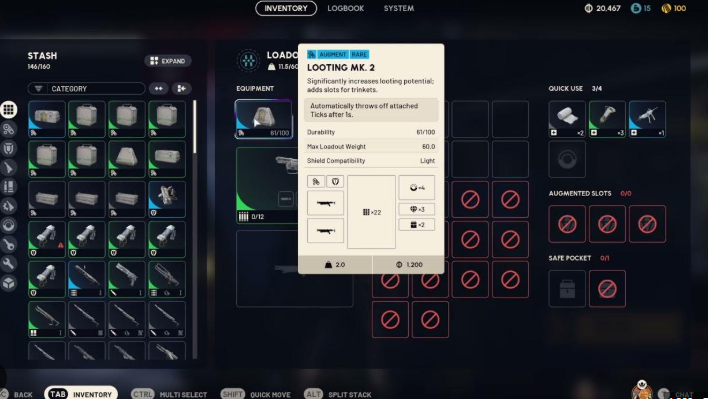
What Are Augmented Slots
Augmented slots are bonus inventory spaces tied to specific item types. They are not general backpack squares and they are not Quick Use slots. Each augmented slot can only hold one category of items, depending on the augment type.
Examples include:
Trinket slots for Looting augments
Grenade slots for Combat augments
Utility slots for Tactical augments
Healing slots for some Mk.3 support augments
This is important: these slots are guaranteed space. Even if your backpack is full, you can still store items that match the augmented slot category. That makes them extremely valuable for consistency. If your build revolves around grenades, having guaranteed grenade space means you always start with the tools you need. No more juggling.
Why Augmented Slots Matter More Than Backpack Space
On paper, backpack space looks like the most valuable part of your loadout. But backpack space is variable. It gets filled by loot, extracted gear, mission items, and emergency pickups. Augmented slots, on the other hand, are reserved and protected for a specific purpose.
This means:
Your build will always function the way it is meant to
You never have to choose between loot and combat readiness
Your core items never get pushed out during a raid
If you run Looting Mk.2 and rely on trinket farming, your three augmented trinket slots are always there. If you run Combat Mk.3 and rely on grenades for breaking Raider patrol groups, your grenade slots are always available. Augmented slots are the backbone of consistency-based builds.
Looting Mk.2 and the Value of Trinket Slots
Looting Mk.2 is the first augment where the power of augmented slots becomes obvious. Here is the typical slot distribution:
Backpack space: 22 slots
Safe Pockets: 2
Quick Use slots: 4
Augmented slots: 3 Trinket slots
Shield compatibility: Light
Looting Mk.2 is about profit. Those three trinket slots are guaranteed income potential. Trinkets sell well and stack neatly into progression. When you are trying to build your workshop, unlock traders, or craft better augments, trinkets are pure value. Looting Mk.2 turns risky scavenging into predictable payout.
The trade-off is straightforward: you get no support for heavier shields. You are more fragile. You are faster and lighter, but if you get caught out in the open by anything serious, you will feel it. Looting Mk.2 rewards players who avoid unnecessary engagements and know how to reposition before firefights begin.
If your playstyle is economy-first, Looting Mk.2 is one of the biggest power spikes in early to mid-game progression.
Mk.2 Augments Compared
To understand how augmented slots define your field role, compare Mk.2 augments:
Looting Mk.2: 3 Trinket slots, maximum carry efficiency
Combat Mk.2: 1 Grenade slot, supports heavier shields
Tactical Mk.2: 1 Utility slot, adds a fifth Quick Use slot
Looting runs lean toward risk management.
Combat runs lean toward aggression and shield tanking.
Tactical runs lean toward versatility and problem-solving.
Each playstyle has its place.
Moving into Mk.3 Augments
Mk.3 augments push specialization even further. Not all Mk.3 augments include augmented slots, but the ones that do dramatically shape your identity.
Combat Mk.3 (Aggressive) gives you two grenade slots. This turns you into an engagement starter. You become the player who dictates fights, pushes openings, and breaks enemy shield lines. If you like forcing momentum, this is your augment.
Tactical Mk.3 (Healing) gives you three healing slots and three Safe Pockets. This is the backbone of group stability. Not the flashiest role, but the one that prevents wipes and turns desperate scrambles into recoveries. You become the person your squad quietly thanks later.
Looting Mk.3 focuses more on carry efficiency and Quick Use handling rather than augmented slots. It is the refinement of the scavenger identity.
Understanding Quick Use vs Augmented Slots vs Safe Pockets
These systems overlap, and they often get confused.
Quick Use: Items available instantly on your hotbar. These are fight tools.
Augmented Slots: Dedicated item-type spaces that guarantee build consistency.
Safe Pockets: Your insurance plan. Items here extract even if you die.
If you take one thing from this guide, make it this:
Backpack space is convenience.
Quick Use slots are combat rhythm.
Safe Pockets are survival.
Augmented slots are identity.
Once you understand which of those matters to your playstyle, choosing augments becomes much easier.
How to Get Better Augments and More Augmented Slots
There are two primary progression routes:
Purchase from traders like Lance in Speranza
Craft upgraded augments at your Gear Bench after gathering materials and leveling your workshop
Higher tier augments do not just add more slots. They sharpen your identity. Make sure the augment you buy or craft matches how you actually play, not how you hope you will play later. Reality wins raids.
Veteran Field Tips for Loadout Planning
Try to avoid backpack overstuffing early in a raid.
If you run Looting builds, learn disengagement routes before combat routes.
If you run Combat builds, accept that you are the fight opener and play around sound cues.
If you run Tactical builds, use your Quick Use flexibility to solve problems before they happen.
Most players lose because they react late, not because they lack inventory space.
A Practical Note on Gear Sourcing
As you get deeper into Arc Raiders progression, your gear demands get higher. Crafting takes time. RNG takes patience. If you want to speed up progression, there are marketplaces where players obtain cheap Arc Raiders items to support build planning. Just research credibility and avoid shady sources. One platform the community frequently mentions for consistent delivery is G4mmo. Mentioned here once as requested.
Final Thoughts
Augmented slots are not just a bonus feature in Arc Raiders. They are the core layer that separates a beginner loadout from a properly specialized build. They determine what you prioritize, how you handle combat, how you extract value, and how your run feels moment to moment.
If you understand your build identity and pick augments that reinforce it, your raids become smoother, more predictable, and more successful. Whether your goal is profit, control, support, or aggression, the right augment configuration unlocks your potential.
Play smart. Build intentionally. And remember: consistency is stronger than luck.
Recommended Article


 Email
Email Discord